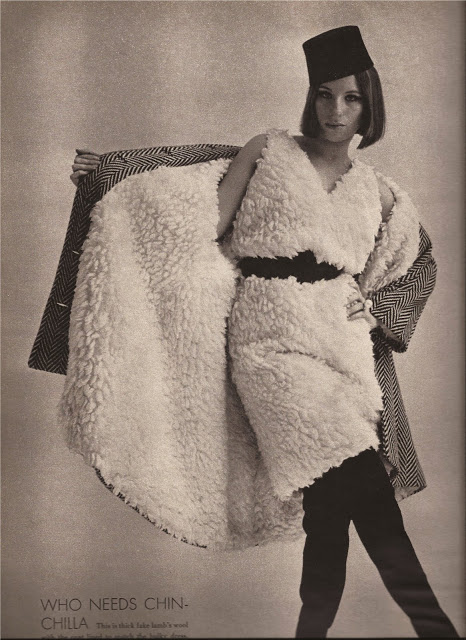
Photographed by the legendary William Claxton (1927–2008), Barbra Streisand’s September 1964 Show magazine editorial launched a lifelong relationship between the star and high fashion. In several photos from the story, titled “Streisand: Gernreich: The This Minute Kids”, Streisand wore a fluffy and fabulous dress and jacket designed by Rudi Gernreich. The plush faux lambswool dress was cinched with a simple belt to accentuate Streisand’s silhouette, and paired with a herringbone jacket featuring a matching lining. The outfit was accessorized with a tall felt pillbox hat, statement faux pearl ring, and thigh-high suede boots. Aptly titled “Who Needs Chinchilla?”, the look poked fun at the popularity of fur at the time, while also reflecting Gernreich’s modern, unconventional approach to fashion.
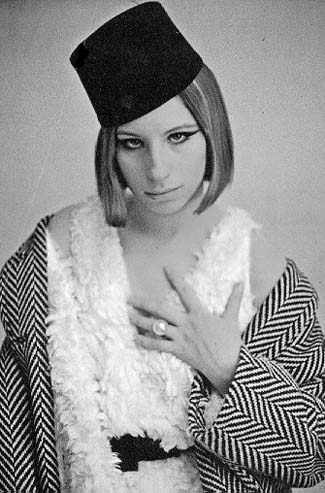
William Claxton later fondly recalled in his memoir how his wife (model and actress Peggy Moffitt) helped Barbra learn how to pose during the shoot by standing by the camera and striking a pose for her to mimic. Moffitt was Gernreich’s close friend, muse, and longtime collaborator, so she instinctively knew how to show off his designs to their fullest effect. “We had a lot of fun, and Barbra was brilliant; she was like a sponge,” Claxton wrote.
Streisand would wear Rudi Gernreich’s designs again in the August 1, 1965, issue of Vogue and the January 1970 issue of LIFE magazine, further highlighting the designer’s influence on her early fashion legacy.
Rudi Gernreich (1922-1985) was one of the twentieth century’s most fearless and avant-garde fashion designers, celebrated for challenging conventions and redefining modern style. Streisand was equally groundbreaking in the 1960s, breaking traditional standards of beauty and celebrity. Gernreich’s daring designs and Streisand’s unapologetic individuality made the perfect pairing. The synergy between the two still translates effortlessly in these photographs, even six decades later.
Far ahead of his time, Gernreich’s vision for fashion was one where men and women were liberated from traditional gender norms. He famously championed the concept of “unisex” dressing and, in 1964, introduced the revolutionary topless Monokini swimsuit. This design became an international sensation and cemented his reputation as one of fashion’s most daring innovators.
Gernreich’s contributions to fashion are endless. Knit tank suits, vibrant stockings, and transparent tops were among his trademarks. He was also the first to use cutouts and create vinyl and plastic clothing. As a former dancer, Gernreich was interested in liberating the body from the limitations of clothing and desexualizing it.
Over the course of his career, Gernreich won four coveted Coty American Fashion Critics awards, solidifying his place as one of the most influential designers of the twentieth century. Following his death in 1985, his muse Peggy Moffitt retained the trademark to his name to continue his legacy.
Barbra Streisand, an early champion of Gernreich’s work, continued to celebrate his legacy decades after first wearing his designs. With her support, Fearless Fashion: Rudi Gernreich, a major retrospective of his career, was presented at the Skirball Cultural Center in Los Angeles from May 9 through September 1, 2019, highlighting the enduring impact of one of fashion’s most fearless innovators on her early career.
Sources:
https://vintagefashionguild.org/resources/item/label/moffitt-peggy/: September 1964 Show Magazine: Faux Lambswool by Rudi Gernreich Show: The Magazine of the Arts. “Streisand: Gernreich: The This Minute Kids”. September 1964. : September 1964 Show Magazine: Faux Lambswool by Rudi Gernreichhttps://www.latimes.com/archives/la-xpm-2008-oct-13-me-claxton13-story.html
https://en.wikipedia.org/wiki/Monokini
https://www.skirball.org/museum/fearless-fashion-rudi-gernreich